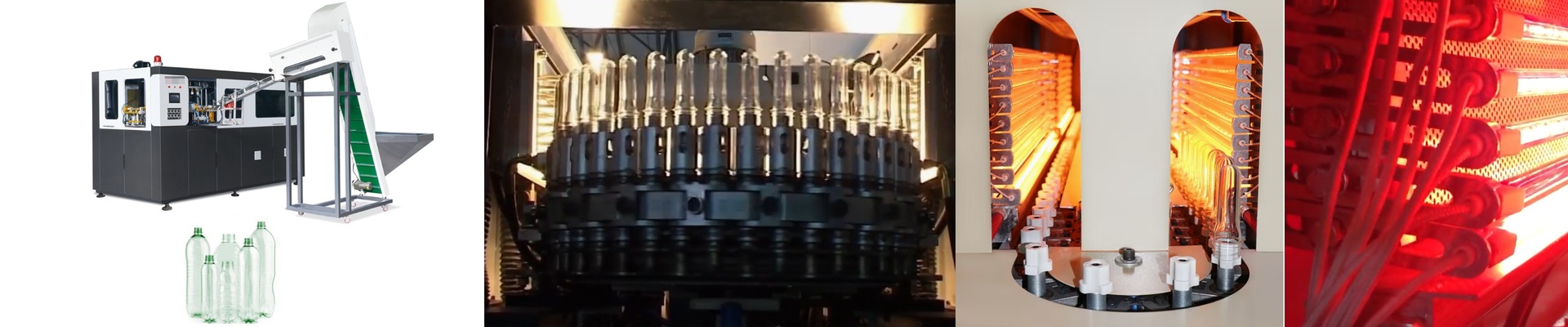
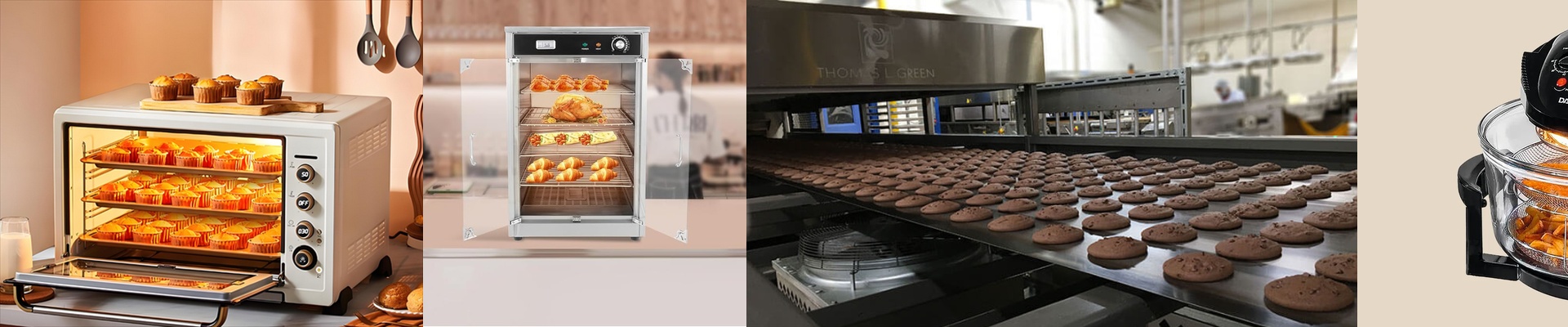
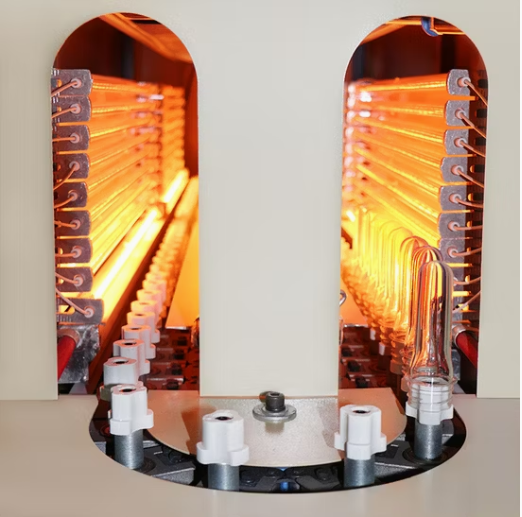
On the blow molding floor, your day is won or lost in the heating tunnel. Preforms come through at the wrong temperature, and you feel it immediately. Too cool, and the bottle splits at the base. Too hot, and you’re fighting haze, weight creep, and a cycle that just won’t settle. It shows up in scrap, in micro-stops, and right there on the electric bill. Swap out an aging halogen or quartz emitter for something that doesn’t match the machine’s original geometry and spectral output, and you’re back to tuning the tunnel every shift. We build short wave infrared emitters for preform heating that drop straight into Sidel, Krones, SIPA, Husky, SACMI, and Nissei ASB blow molders with 1:1 parameter matching. Same power density. Same spectral profile. Same envelope, mounting, and connector interface. This isn’t about novelty. It’s about repeatability.
What matters, technically
Short wave infrared (SWIR) heats preforms primarily through surface absorption, which gives you fast response and tight thermal control—exactly what stretch blow molding needs. The physics are straightforward: the emitted spectrum peaks around 1.0–1.2 μm, and the PET surface absorbs that energy efficiently. The quartz envelope and reflector geometry keep the energy where it needs to be. Our emitters are engineered to hit the OEM-equivalent specs you expect on these mainstream machines:
- Power and density: 1,000–4,000 W per lamp, sized to deliver 18–32 W/cm² at the preform path. That matches the original lamp’s heat flux so you don’t have to re-engineer the heating curve.
- Voltage and current: 230 V or 460 V configurations, with current draw within ±3% of the OEM rating. That keeps contactors, SSRs, and PID loops working in the range they were designed for.
- Spectral output: Peak wavelength in the 1.0–1.2 μm band, tuned to PET absorption for fast, even surface heating without over-penetrating the wall thickness.
- Envelope and geometry: Straight or custom-bent quartz tubes, OD 10–16 mm, with overall lengths to match the original footprint—including the specific arc length and focal position used in your heating tunnel.
- Connector type: R7s base, gyro socket, or custom pin/quick-connect per machine model, built to the exact mating interface so the lamp seats flush and aligns to the reflector.
- Temperature tolerance: Quartz tube rated for continuous operation above 900°C, with an internal halogen filament construction that holds output stable over long runs.
- Electrical interface: Terminals or connectors compatible with existing wiring harnesses, including polarity and insulation spacing to OEM standards. If you’re swapping lamps on a Sidel SBO, Krones Contiform, SIPA SFL, Husky Hypet, SACMI Rotary, or Nissei ASB, these numbers aren’t marketing. They’re the only way the heating profile stays stable when you change lamps.
Why this works in the real world
In preform heating, the win isn’t just “more heat.” It’s predictable heat—fast enough to keep pace with the machine, and repeatable from lamp to lamp.
- Faster stabilization, less scrap: SWIR emitters hit target output in seconds. When you start the line, the tunnel comes up quickly, and the first bottles are on spec sooner. During grade changes, the PID loop settles faster because the lamp response is consistent.
- Tighter thermal uniformity: The short wave output, paired with proper reflector alignment, gives you even heating across the preform surface. That means less localized thinning, more consistent top load, and fewer splits.
- Energy use that makes sense: Short wave heats the preform surface directly, so you waste less energy heating air and fixtures. In practice, many lines see single-digit percentage reductions in kWh per thousand bottles after replacing old lamps with properly matched SWIR emitters—though the exact number depends on your cycle, mass, and duty cycle.
- Longer run intervals, fewer changeouts: We target 5,000+ hours of stable output in typical duty cycles, with less than 5% lumen/output decay. Fewer lamp changes, fewer stoppages, and less maintenance labor tied to the heating tunnel.
- Direct fit, no re-engineering: Because the lamp matches the original dimensions, mounting points, and electrical interface, you can swap in and out without touching brackets, reflectors, or wiring looms. You keep your existing control strategy and tooling. This matters when you’re running 48,000–72,000 bottles per hour and the heating tunnel is the bottleneck. It matters when you have to hit a specific bottle weight and still meet top-load spec. And it matters when you’re running multiple SKUs and can’t afford a 30-minute retune every time you change colors.
A few practical things to check first
A matched emitter only performs if the surrounding system is in order. Before you change lamps, run through these three items:
- Reflector condition: Reflectors degrade. If you’ve got oxidation, pitting, or warping, the lamp can be perfect and the heating profile will still drift. Replace reflectors at the same time as the lamp if they show visible wear.
- Thermal alignment: Lamp position relative to the preform path—focal point and clearance—needs to match the OEM setup. Even a millimeter off can shift the temperature curve and show up as uneven wall thickness.
- Electrical health: Loose connections, undersized wiring, and tired SSRs cause voltage drop and uneven lamp life. Measure at the lamp terminals under load; if you’re not seeing nameplate voltage, the lamp can’t do its job. Also, keep expectations grounded: SWIR emitters are sensitive to ambient temperature and airflow around the heating zone. In very hot or drafty environments, the control loop may need tighter tuning or additional shielding to hold the same repeatability. We provide setpoints and PID guidance per machine model, but plant conditions vary. If you’re running Sidel, Krones, SIPA, Husky, SACMI, or Nissei ASB, tell us the machine, the heating tunnel model, and the original lamp part number. We’ll supply a short wave infrared emitter that matches the power, geometry, and interface specs—so your blow molder keeps doing what it was built to do.